2026 OX5 Hall of Fame Inductee – Orin Welch
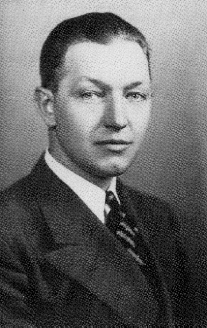
Orin Moore Welch (1906 to 1943) left an enduring and indelible contribution to aviation throughout his 36 years as an aircraft mechanic, barnstormer, flight instructor, demonstration pilot, air race winner, corporate pilot, airport manager, aircraft designer, inventor, test pilot, and World War II hero.[i] Orin first achieved local fame as a barnstorming and instructor pilot throughout the Midwest, making numerous piloting firsts in the area. He led the development and management of four airfields: two in West Virginia and two in Indiana. Always an entrepreneur, Orin established flight schools at each of these airports. From 1927 to 1940 in Indiana, Orin founded an aircraft manufacturing business, where he designed, built, test-flew, and sold numerous aircraft nationwide for recreational and training purposes. A self-taught engineer and innovator, he patented a tubeless airplane tire in 1940. Orin volunteered and served as a Pan Am ferry pilot, then went missing as a combat pilot flying the Hump in 1943.
Born in 1906 in Ohio as the oldest of four, he first glimpsed an airplane along the Ohio River during the Great War. Orin immediately caught the aviation bug and decided to follow in that pilot’s footsteps. After finishing eighth grade, he began working for ex-Army pilot L.H. “Scotty” Scott (pilot license number 309 – Early Bird) as an aircraft mechanic. He quickly began flying lessons from Scotty, soloing a Curtiss JN-4, and earned his pilot certificate—signed by Orville Wright—shortly thereafter.[ii] As with all starving aviators then, he made a living barnstorming his Standard J-1 through central Indiana, Ohio, and West Virginia. A local newspaper cited a speed record set by Orin from Columbus to Huntington,[iii] along with the first-ever seaplane seen in the area, which Orin purchased and flew on the Ohio River.[iv]
At eighteen, Orin left with the aircraft maintenance and barnstorming knowledge he gained from Scotty and moved to West Virginia to start his own business. Once there, he established two airports, where he both barnstormed and managed a flight school, graduating his first class in 1925. By late 1926, the city of Anderson, Indiana was looking for a new manager for the Anderson Aircraft Company and local airport—a position Orin accepted.
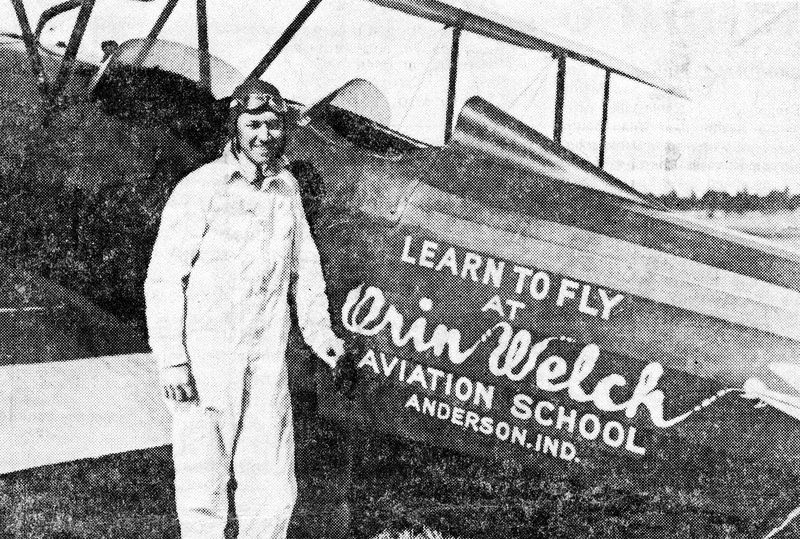
Immediately after the move to Indiana, Orin began to design and manufacture his own line of aircraft. Initially using Swallow fuselages and modifying them with different wings, tail surfaces, and landing gear, he later completely designed his own biplane. Only six Welch biplanes were produced as Orin continued to tinker with unique designs, including a parasol and a cabin monoplane, all OX5-powered. These aircraft types allowed Orin to begin charter services transporting passengers between cities within Indiana. He continued flight instruction at the Orin Welch Flight School, employing 20 people and graduating over 300 students, dramatically expanding the pool of trained aviators.[v] Aerial exhibitions were common during the early years of the Orin Welch Flying Field, as the country was fascinated with aviation. These exhibits included fireworks launched from airplanes, parachute leaps, wing walking, and aerobatics.
As Orin’s business grew, he required a larger venue and the Welch Airfield was born. Still in Anderson, the official dedication occurred Memorial Day weekend of 1929,[vi] and included dignitaries such as Anthony Fokker, Amelia Earhart, Eddie Rickenbacker, and Weir Cook. Features included aerial exhibitions from the Goodyear dirigible “Puritan” and numerous Army aircraft, time-to-climb contests, aerobatic displays, and speeches on the future of aviation. This dedication bolstered the town’s economy and led to air races, air shows, flight demonstrations and distribution for aircraft sales, an Indiana Air Tour, and commercial passenger operations all from Orin’s airport. His pilot accomplishments during this time include flight testing and demonstrations for the Aircraft Corporation of America, Lincoln Aircraft Company, and Swallow Airplane Company, acting as Swallow’s demo pilot during the 1929 Cleveland National Air Races—winning the Deadstick Landing contest and Balloon Bursting contest.[vii]
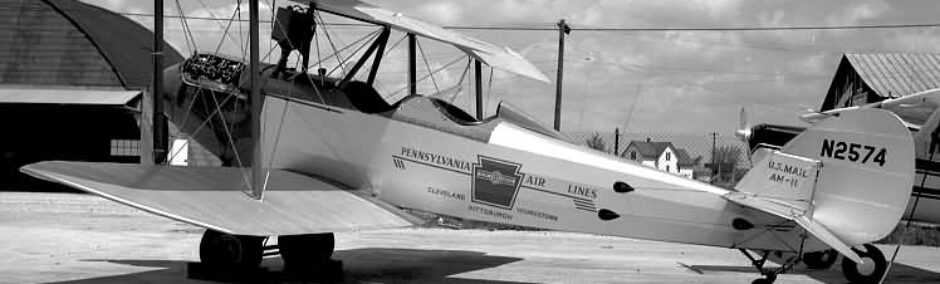
Later in 1929, Orin designed his first light (flivver) aircraft, which flew in 1931, resembled an Aeronca C-3, and was initially powered by a Continental A-40 engine.[viii] Welch Aircraft Industries produced 50 aircraft over the next nine years, designated the OW-5M through OW-8M.[ix] One of the engine types used was his own design, the Welch O-2 engine. They were two-cylinder, opposed, direct-driven, air-cooled, 45-horsepower engines built in his Anderson factory.[x] Orin built and test flew each one, before selling them throughout the country for private and flight school use. They received FAA Type Certificates #637 (OW-6M) and #638 (OW-5M).[xi]
Although much of Orin’s time was filled by his line of light aircraft and managing the airport and flight school, he was still an aviator at heart. He wrote a series of newspaper articles detailing his corporate flying adventures for Paul Snick. These adventures were primarily flown in cabin Wacos and covered thirty-eight states, Canada, and Mexico. Among his extraordinary breadth of capabilities, he and Clyde Schokley were the first in the state of Indiana to be licensed to fly a glider in the summer of 1932.[xii]
After moving to South Bend, Indiana, in 1936, Orin applied for a patent for his “Inflatable Tire” on February 10, 1937, receiving U.S. Patent No. 2,190,905 on February 20, 1940. This tubeless, inflatable airplane tire was built around a small aluminum hub produced in his company’s foundry and used on the Welch OW-5M through OW-9M aircraft. According to the U.S. Patent Office, Orin’s design centered on improving landing gear by providing substantial shock absorption while minimizing weight and adding strength. It also incorporated a larger cross-sectional area to further enhance cushioning upon touchdown. Thanks to this low-pressure design, aircraft could be built without conventional shock absorbers.[xiii]
After the attack on Pearl Harbor, Orin instantly volunteered for service. His résumé consisted of a Commercial Pilot Certificate (No. 1845 earned in 1927)—the highest license at the time—an Airplane and Engine Mechanic’s Certificate (No. 3708), Commercial Glider Pilot Certificate (No. 131), Federal Aeronautique Internationale (No. 7219), Flight Instructor rating with 2,000 instructor hours, and recognized project engineer and test pilot by the CAA. He was a single, 35-year-old with over 7,200 flight hours in his logbook and wanted to serve with the best use of his talents.[xiv] Although his “old age” precluded combat flight service, he received an offer to flight instruct for the Navy in Pensacola. Always the adventurer, he chose Pan American Airways Ferry Command and began ferrying bombers to Africa, Europe, and Asia in January. Dissolved in October 1942, he transitioned to the China National Aviation Corporation (CNAC) in November.
At CNAC, Orin flew supplies between India over Burma to China. Known as “the Hump,” thousands of aircrews served along this unforgiving route supplying China from 1941 to 1945. Unfortunately, the civilian aircrew of CNAC are forgotten remnants of an operation vital to the China-Burma-India theater and Allied victory in the Pacific. The unforgiving Himalayan Mountain range along the route bore peaks reaching over 19,000 feet. The aircraft were neither pressurized nor climate-controlled, and losing an engine required immediately dumping the cargo before flying into a mountain. Despite these dangers, it was the unpredictable weather which scared and killed hump pilots more than anything else. Japanese fighter patrols also roamed the area. “Flying the Hump” was a dangerous business and the nickname “Aluminum Trail” was coined to signify the ability to navigate the route using only scattered aircraft wreckage below.
Four months after Orin’s arrival, disaster struck on March 13th, 1943.[xv],[xvi],[xvii] Four C-53s were flown from Dinjan, India to Kunming, China with precious 50-gallon drums of high-octane aviation fuel for air forces in China. Orin led the returning flight to Dinjan with 100-pound tin ingots tied down with the same rope used for the drums.[xviii] A thunderstorm developed over the Himalayas and the four split up, one returning to China as the other three tried for home.[xix] One C-53 entered the storm at 15,000 feet, met incredible turbulence, and executed a 180° turn to exit. Popping out of the storm in an updraft at 23,000 feet, the tin bars broke loose and sliced through the aluminum skin, leaving the aircraft without a single tin bar inside. Orin was not so lucky, and his aircraft was never seen again. CNAC assumed the same event occurred and cut his control cables.
H.M. Bixby, Vice President of Pan American Airways, notified the Welch family by elucidating Orin’s service and sacrifice. His telegram stated, “The secret route over which Orin was flying for CNAC is the same route flown by the U.S. Army Air Transport Command in keeping at a constant pace the flow of strategic war materials to and from China. He flew the same type of planes and carried the same valuable cargo as did uniformed American Army transport pilots. He has truly been in the service of his country.”[xx] Orin’s death devastated the family and summarily ended the Welch Aircraft Company.
The India-China ferrying operation was the largest and most extensive strategic air bridge in history until surpassed by the Berlin Airlift. They delivered every drop of fuel, weapon, and piece of ammunition used by American forces in China at a cost of nearly six hundred aircraft and over 1,700 aircrew. General Albert C. Wedemeyer, Commander of U.S. Forces in China, stated “Flying the ‘Hump’ was the foremost and by far the most dangerous, difficult and historic achievement of the entire war.”
Orin’s influence did not end with his passing but extended into the lives of his family and subsequent generations. Four of his sibling’s children or grandchildren became professional aviators. These include: An F-4 and E-3 navigator who perished in Yukla 27 in Alaska in 1995, a Captain flying the north slope in Alaska for ConocoPhillips, an Air Force and United Airlines test pilot, and an Atlas Airlines and Southwest Airlines pilot, with numerous other family members soloing aircraft or earning their private certificates. In addition to new aviators, the Midwest was left with new airports, new flight schools, and new aircraft in the wake of Orin’s death and heroic service during WWII. And although these physical manifestations of his life’s work and passion can become lost to the natural degradations of time, Orin Welch’s vision, courage, and pioneering spirit still permeate the milieu of aviation. Hopefully, his induction into the OX5 Hall of Fame will serve to inspire tomorrow’s aviators with that same zeal.
[i]
[i] “Pioneering flight in Anderson, Indiana: Orin Welch and his short-lived airport provided thrills,” Kathryn’s Report, 8 May 2016, http://www.kathrynsreport.com/2016/05/pioneering-flight-in-anderson-indiana.html.
[ii]
[ii] The Welch Airplane Story, Drina Welch Abel, The Sunshine House, 1983, Page 4.
[iii]
[iii] The Welch Airplane Story, Drina Welch Abel, The Sunshine House, 1983, Page 6.
[iv]
[iv] The Welch Airplane Story, Drina Welch Abel, The Sunshine House, 1983, Page 7.
[v]
[v] The Welch Airplane Story, Drina Welch Abel, The Sunshine House, 1983, Page 87.
[vi]
[vi] The Welch Airplane Story, Drina Welch Abel, The Sunshine House, 1983, Pages 24-28.
[vii]
[vii] The Welch Airplane Story, Drina Welch Abel, The Sunshine House, 1983, Pages 32-33.
[viii]
[viii] Flying with 40 Horses: A History of the Continental A-40 Aircraft Engine and the Planes it Flew, Chester L. Peek, Three Peaks Publishing, 2001, Pages 103-108.
[ix]
[ix] “L-Birds of a Feather Mock Together,” Connect Communications, 16 October 2022, https://mtay.us/2022/10/.
[x]
[x] Flying with 40 Horses: A History of the Continental A-40 Aircraft Engine and the Planes it Flew, Chester L. Peek, Three Peaks Publishing, 2001, Pages 107.
[xi]
[xi] U.S. Civil Aircraft Series Volume 7: ATC 601-700, Joseph P. Juptner, TAB AERO, 1994.
[xii]
[xii] The Welch Airplane Story, Drina Welch Abel, The Sunshine House, 1983.
[xiii]
[xiii] “Inflatable Tire,” United States Patent Office, 1940.
[xiv]
[xiv] The Welch Airplane Story, Drina Welch Abel, The Sunshine House, 1983.
[xv]
[xv] The Aluminum Trail, Chick Marrs Quinn, 1989, page 10.
[xvi]
[xvi] The Dragon’s Wings: The China National Aviation Corporation and the Development of Commercial Aviation in China, William M. Leary, Jr., The University of Georgia Press, 1976, page 163.
[xvii]
[xvii] China’s Wings, Gregory Crouch, Bantom Books, 2012, pages 300-302.
[xviii]
[xviii] Himalayan Rogue: A Pilot’s Odyssey, Peter Goutiere, Turner Publishing Company, 1994, pages 80-81.
[xix]
[xix] Peter Goutiere, Interview, May 2017.
[xx]
[xx] The Welch Airplane Story, Drina Welch Abel, The Sunshine House, 1983.