CBW Owned Items at the KLBE museum
by Greg Gaynor, National President
For 11 years, the OX5 Aviation Pioneers have awarded aviation training scholarships with the goal of supporting young men and women in their efforts toward an aviation career.
In 2026, the OX5 Aviation Pioneers will award two $1000 scholarships for aviation education for those who are working towards a career in aviation.
The application deadline for the Educational Scholarship is July 15, 2026.
Download the application from this button.

Additionally, a $500 Discover Aviation scholarship will be available for children aged 12-16 who would like to attend an aviation camp.
The application deadline for the Discover Aviation Scholarship is August 1, 2026.

Send completed scholarship applications by July 15, 2026 to:
OX5 Aviation Pioneers
Attn: Scholarship Program
PO Box 769
Troy, Ohio 45373


2026 OX5 Hall of Fame Inductee – Orin Welch
Orin Moore Welch (1906 to 1943) left an enduring and indelible contribution to aviation throughout his 36 years as an aircraft mechanic, barnstormer, flight instructor, demonstration pilot, air race winner, corporate pilot, airport manager, aircraft designer, inventor, test pilot, and World War II hero.[i] Orin first achieved local fame as a barnstorming and instructor pilot throughout the Midwest, making numerous piloting firsts in the area. He led the development and management of four airfields: two in West Virginia and two in Indiana. Always an entrepreneur, Orin established flight schools at each of these airports. From 1927 to 1940 in Indiana, Orin founded an aircraft manufacturing business, where he designed, built, test-flew, and sold numerous aircraft nationwide for recreational and training purposes. A self-taught engineer and innovator, he patented a tubeless airplane tire in 1940. Orin volunteered and served as a Pan Am ferry pilot, then went missing as a combat pilot flying the Hump in 1943.
Born in 1906 in Ohio as the oldest of four, he first glimpsed an airplane along the Ohio River during the Great War. Orin immediately caught the aviation bug and decided to follow in that pilot’s footsteps. After finishing eighth grade, he began working for ex-Army pilot L.H. “Scotty” Scott (pilot license number 309 – Early Bird) as an aircraft mechanic. He quickly began flying lessons from Scotty, soloing a Curtiss JN-4, and earned his pilot certificate—signed by Orville Wright—shortly thereafter.[ii] As with all starving aviators then, he made a living barnstorming his Standard J-1 through central Indiana, Ohio, and West Virginia. A local newspaper cited a speed record set by Orin from Columbus to Huntington,[iii] along with the first-ever seaplane seen in the area, which Orin purchased and flew on the Ohio River.[iv]
At eighteen, Orin left with the aircraft maintenance and barnstorming knowledge he gained from Scotty and moved to West Virginia to start his own business. Once there, he established two airports, where he both barnstormed and managed a flight school, graduating his first class in 1925. By late 1926, the city of Anderson, Indiana was looking for a new manager for the Anderson Aircraft Company and local airport—a position Orin accepted.
Immediately after the move to Indiana, Orin began to design and manufacture his own line of aircraft. Initially using Swallow fuselages and modifying them with different wings, tail surfaces, and landing gear, he later completely designed his own biplane. Only six Welch biplanes were produced as Orin continued to tinker with unique designs, including a parasol and a cabin monoplane, all OX5-powered. These aircraft types allowed Orin to begin charter services transporting passengers between cities within Indiana. He continued flight instruction at the Orin Welch Flight School, employing 20 people and graduating over 300 students, dramatically expanding the pool of trained aviators.[v] Aerial exhibitions were common during the early years of the Orin Welch Flying Field, as the country was fascinated with aviation. These exhibits included fireworks launched from airplanes, parachute leaps, wing walking, and aerobatics.
As Orin’s business grew, he required a larger venue and the Welch Airfield was born. Still in Anderson, the official dedication occurred Memorial Day weekend of 1929,[vi] and included dignitaries such as Anthony Fokker, Amelia Earhart, Eddie Rickenbacker, and Weir Cook. Features included aerial exhibitions from the Goodyear dirigible “Puritan” and numerous Army aircraft, time-to-climb contests, aerobatic displays, and speeches on the future of aviation. This dedication bolstered the town’s economy and led to air races, air shows, flight demonstrations and distribution for aircraft sales, an Indiana Air Tour, and commercial passenger operations all from Orin’s airport. His pilot accomplishments during this time include flight testing and demonstrations for the Aircraft Corporation of America, Lincoln Aircraft Company, and Swallow Airplane Company, acting as Swallow’s demo pilot during the 1929 Cleveland National Air Races—winning the Deadstick Landing contest and Balloon Bursting contest.[vii]
Later in 1929, Orin designed his first light (flivver) aircraft, which flew in 1931, resembled an Aeronca C-3, and was initially powered by a Continental A-40 engine.[viii] Welch Aircraft Industries produced 50 aircraft over the next nine years, designated the OW-5M through OW-8M.[ix] One of the engine types used was his own design, the Welch O-2 engine. They were two-cylinder, opposed, direct-driven, air-cooled, 45-horsepower engines built in his Anderson factory.[x] Orin built and test flew each one, before selling them throughout the country for private and flight school use. They received FAA Type Certificates #637 (OW-6M) and #638 (OW-5M).[xi]
Although much of Orin’s time was filled by his line of light aircraft and managing the airport and flight school, he was still an aviator at heart. He wrote a series of newspaper articles detailing his corporate flying adventures for Paul Snick. These adventures were primarily flown in cabin Wacos and covered thirty-eight states, Canada, and Mexico. Among his extraordinary breadth of capabilities, he and Clyde Schokley were the first in the state of Indiana to be licensed to fly a glider in the summer of 1932.[xii]
After moving to South Bend, Indiana, in 1936, Orin applied for a patent for his “Inflatable Tire” on February 10, 1937, receiving U.S. Patent No. 2,190,905 on February 20, 1940. This tubeless, inflatable airplane tire was built around a small aluminum hub produced in his company’s foundry and used on the Welch OW-5M through OW-9M aircraft. According to the U.S. Patent Office, Orin’s design centered on improving landing gear by providing substantial shock absorption while minimizing weight and adding strength. It also incorporated a larger cross-sectional area to further enhance cushioning upon touchdown. Thanks to this low-pressure design, aircraft could be built without conventional shock absorbers.[xiii]
After the attack on Pearl Harbor, Orin instantly volunteered for service. His résumé consisted of a Commercial Pilot Certificate (No. 1845 earned in 1927)—the highest license at the time—an Airplane and Engine Mechanic’s Certificate (No. 3708), Commercial Glider Pilot Certificate (No. 131), Federal Aeronautique Internationale (No. 7219), Flight Instructor rating with 2,000 instructor hours, and recognized project engineer and test pilot by the CAA. He was a single, 35-year-old with over 7,200 flight hours in his logbook and wanted to serve with the best use of his talents.[xiv] Although his “old age” precluded combat flight service, he received an offer to flight instruct for the Navy in Pensacola. Always the adventurer, he chose Pan American Airways Ferry Command and began ferrying bombers to Africa, Europe, and Asia in January. Dissolved in October 1942, he transitioned to the China National Aviation Corporation (CNAC) in November.
At CNAC, Orin flew supplies between India over Burma to China. Known as “the Hump,” thousands of aircrews served along this unforgiving route supplying China from 1941 to 1945. Unfortunately, the civilian aircrew of CNAC are forgotten remnants of an operation vital to the China-Burma-India theater and Allied victory in the Pacific. The unforgiving Himalayan Mountain range along the route bore peaks reaching over 19,000 feet. The aircraft were neither pressurized nor climate-controlled, and losing an engine required immediately dumping the cargo before flying into a mountain. Despite these dangers, it was the unpredictable weather which scared and killed hump pilots more than anything else. Japanese fighter patrols also roamed the area. “Flying the Hump” was a dangerous business and the nickname “Aluminum Trail” was coined to signify the ability to navigate the route using only scattered aircraft wreckage below.
Four months after Orin’s arrival, disaster struck on March 13th, 1943.[xv],[xvi],[xvii] Four C-53s were flown from Dinjan, India to Kunming, China with precious 50-gallon drums of high-octane aviation fuel for air forces in China. Orin led the returning flight to Dinjan with 100-pound tin ingots tied down with the same rope used for the drums.[xviii] A thunderstorm developed over the Himalayas and the four split up, one returning to China as the other three tried for home.[xix] One C-53 entered the storm at 15,000 feet, met incredible turbulence, and executed a 180° turn to exit. Popping out of the storm in an updraft at 23,000 feet, the tin bars broke loose and sliced through the aluminum skin, leaving the aircraft without a single tin bar inside. Orin was not so lucky, and his aircraft was never seen again. CNAC assumed the same event occurred and cut his control cables.
H.M. Bixby, Vice President of Pan American Airways, notified the Welch family by elucidating Orin’s service and sacrifice. His telegram stated, “The secret route over which Orin was flying for CNAC is the same route flown by the U.S. Army Air Transport Command in keeping at a constant pace the flow of strategic war materials to and from China. He flew the same type of planes and carried the same valuable cargo as did uniformed American Army transport pilots. He has truly been in the service of his country.”[xx] Orin’s death devastated the family and summarily ended the Welch Aircraft Company.
The India-China ferrying operation was the largest and most extensive strategic air bridge in history until surpassed by the Berlin Airlift. They delivered every drop of fuel, weapon, and piece of ammunition used by American forces in China at a cost of nearly six hundred aircraft and over 1,700 aircrew. General Albert C. Wedemeyer, Commander of U.S. Forces in China, stated “Flying the ‘Hump’ was the foremost and by far the most dangerous, difficult and historic achievement of the entire war.”
Orin’s influence did not end with his passing but extended into the lives of his family and subsequent generations. Four of his sibling’s children or grandchildren became professional aviators. These include: An F-4 and E-3 navigator who perished in Yukla 27 in Alaska in 1995, a Captain flying the north slope in Alaska for ConocoPhillips, an Air Force and United Airlines test pilot, and an Atlas Airlines and Southwest Airlines pilot, with numerous other family members soloing aircraft or earning their private certificates. In addition to new aviators, the Midwest was left with new airports, new flight schools, and new aircraft in the wake of Orin’s death and heroic service during WWII. And although these physical manifestations of his life’s work and passion can become lost to the natural degradations of time, Orin Welch’s vision, courage, and pioneering spirit still permeate the milieu of aviation. Hopefully, his induction into the OX5 Hall of Fame will serve to inspire tomorrow’s aviators with that same zeal.
[i]
[i] “Pioneering flight in Anderson, Indiana: Orin Welch and his short-lived airport provided thrills,” Kathryn’s Report, 8 May 2016, https://www.kathrynsreport.com/2016/05/pioneering-flight-in-anderson-indiana.html.
[ii]
[ii] The Welch Airplane Story, Drina Welch Abel, The Sunshine House, 1983, Page 4.
[iii]
[iii] The Welch Airplane Story, Drina Welch Abel, The Sunshine House, 1983, Page 6.
[iv]
[iv] The Welch Airplane Story, Drina Welch Abel, The Sunshine House, 1983, Page 7.
[v]
[v] The Welch Airplane Story, Drina Welch Abel, The Sunshine House, 1983, Page 87.
[vi]
[vi] The Welch Airplane Story, Drina Welch Abel, The Sunshine House, 1983, Pages 24-28.
[vii]
[vii] The Welch Airplane Story, Drina Welch Abel, The Sunshine House, 1983, Pages 32-33.
[viii]
[viii] Flying with 40 Horses: A History of the Continental A-40 Aircraft Engine and the Planes it Flew, Chester L. Peek, Three Peaks Publishing, 2001, Pages 103-108.
[ix]
[ix] “L-Birds of a Feather Mock Together,” Connect Communications, 16 October 2022, https://mtay.us/2022/10/.
[x]
[x] Flying with 40 Horses: A History of the Continental A-40 Aircraft Engine and the Planes it Flew, Chester L. Peek, Three Peaks Publishing, 2001, Pages 107.
[xi]
[xi] U.S. Civil Aircraft Series Volume 7: ATC 601-700, Joseph P. Juptner, TAB AERO, 1994.
[xii]
[xii] The Welch Airplane Story, Drina Welch Abel, The Sunshine House, 1983.
[xiii]
[xiii] “Inflatable Tire,” United States Patent Office, 1940.
[xiv]
[xiv] The Welch Airplane Story, Drina Welch Abel, The Sunshine House, 1983.
[xv]
[xv] The Aluminum Trail, Chick Marrs Quinn, 1989, page 10.
[xvi]
[xvi] The Dragon’s Wings: The China National Aviation Corporation and the Development of Commercial Aviation in China, William M. Leary, Jr., The University of Georgia Press, 1976, page 163.
[xvii]
[xvii] China’s Wings, Gregory Crouch, Bantom Books, 2012, pages 300-302.
[xviii]
[xviii] Himalayan Rogue: A Pilot’s Odyssey, Peter Goutiere, Turner Publishing Company, 1994, pages 80-81.
[xix]
[xix] Peter Goutiere, Interview, May 2017.
[xx]
[xx] The Welch Airplane Story, Drina Welch Abel, The Sunshine House, 1983.
Thank you for your continued support!

Best regards,
The Board of Governors
 Many members donate extra funds which helps our Scholarship projects. .
Draw your check for $ 30.00 to:
OX5 Aviation Pioneers .
PO Box 769 Troy, Ohio 45373
Or use PayPal online below
 https://ox5.org/renew-membership/
 DATE SET !
11-6-2025

Dennis G Yerkey
2026 Nat Gov, Pres Cliff Ball Wing-Pittsburgh Pa, Past National Pres, Webmaster

We want to thank W.K. Skinner for providing the newsletters for our website.
Scanning was paid by the OX5 Aviation Pioneers National Treasury.
Arrow down at lower left or wheel down to view next page.
Scroll down or Wheel down to move to the next newsletter.
0001_197208 Vol 14 No 4 OX5 News 0002_197212 Vol 14 No 6 OX5 News 0003_197302 Vol 15 No 1 OX5 News 0004_197304 Vol 15 No 2 OX5 News 0005_197306 Vol 15 No 3 OX5 News
0006_197308 Vol 15 No 4 OX5 News 0007_197310 Vol 15 No 5 OX5 News 0008_197312 Vol 15 No 6 OX5 News 0009_197402 Vol 16 No 1 OX5 News 0010_197404 Vol 16 No 2 OX5 News 0011_197406 Vol 16 No 3 OX5 News 0012_197408 Vol 16 No 4 OX5 News 0013_197410 Vol 16 No 5 OX5 News 0014_197412 Vol 16 No 6 OX5 News 0015_197502 Vol 17 No 1 OX5 News 0016_197506 Vol 17 No 3 OX5 News 0017_197512 Vol 17 No 6 OX5 News 0018_197602 Vol 18 No 1 OX5 News 0019_197812 Vol 20 No 6 OX5 News 0020_197902 Vol 21 No 1 OX5 News
.
0021_197904 Vol 21 No 2 OX5 News 0022_197906 Vol 21 No 3 OX5 News 0023_197908 Vol 21 No 4 OX5 News 0024_197910 Vol 21 No 5 OX5 News 0025_197912 Vol 21 No 6 OX5 News 0026_198002 Vol 22 No 1 OX5 News 0027_198004 Vol 22 No 2 OX5 News 0028_198006 Vol 22 No 3 OX5 News 0029_198008 Vol 22 No 4 OX5 News 0030_198010 Vol 22 No 5 OX5 News
.
0031_198012 Vol 22 No 6 OX5 News 0032_198102 Vol 23 No 1 OX5 News 0033_198104 Vol 23 No 2 OX5 News 0034_198106 Vol 23 No 3 OX5 News 0035_198108 Vol 23 No 4 OX5 News 0036_198110 Vol 23 No 5 OX5 News 0037_198112 Vol 23 No 6 OX5 News 0038_198202 Vol 24 No 1 OX5 News 0039_198206 Vol 24 No 3 OX5 News 0040_198210 Vol 24 No 5 OX5 News 0041_198212 Vol 24 No 6 OX5 News 0042_198410 Vol 26 No 5 OX5 News 0043_198412 Vol 26 No 6 OX5 News 0044_198502 Vol 27 No 1 OX5 News 0045_198504 Vol 27 No 2 OX5 News 0046_198506 Vol 27 No 3 OX5 News 0047_198508 Vol 27 No 4 OX5 News 0048_198510 Vol 27 No 5 OX5 News 0049_198512 Vol 27 No 6 OX5 News 0050_198602 Vol 28 No 1 OX5 News
.
0051_198604 Vol 28 No 2 OX5 News 0052_198606 Vol 28 No 3 OX5 News 0053_198608 Vol 28 No 4 OX5 News 0054_198610 Vol 28 No 5 OX5 News 0055_198612 Vol 28 No 6 OX5 News 0056_198702 Vol 29 No 1 OX5 News 0057_198704 Vol 29 No 2 OX5 News 0058_198706 Vol 29 No 3 OX5 News 0059_198708 Vol 29 No 4 OX5 News 0060_198710 Vol 29 No 5 OX5 News 0061_198802 Vol 30 No 1 OX5 News 0062_198804 Vol 30 No 2 OX5 News 0063_198806 Vol 30 No 3 OX5 News 0064_198808 Vol 30 No 4 OX5 News 0065_198810 Vol 30 No 5 OX5 News 0066_198812 Vol 30 No 6 OX5 News 0067_198902 Vol 31 No 1 OX5 News 0068_198904 Vol 31 No 2 OX5 News 0069_198906 Vol 31 No 3 OX5 News 0070_198908 Vol 31 No 4 OX5 News 0071_198910 Vol 31 No 5 OX5 News 0072_198912 Vol 31 No 6 OX5 News
.

Left to right: Don’s sons Jeff and Rick, Don’s widow Jeanette, and Wisc. Wing President Dave Hedgecock.
Attached is a photo of Don’s inclusion on the OX-5 Wall of Fame at the Curtiss Museum. The staff of the Museum have been great to work with throughout this mission.

Voland posted to Hall of Fame wall.

CBW PDF 08302013 CBW PDF 08302013_0001 CBW PDF 08302013_0002 CBW PDF 08302013_0003 CBW PDF 08302013_0004
505 pages with lots of great photos from 1929.
Use the down arrow on lower left of book page to move to next page.
.
THE-1929-AIRCRAFT-YEAR-BOOK (1)
HISTORY OF THE HALL OF FAME
Airplanes powered by Curtiss-built Model OX5 engines represented a period when flight grew from a side-show business to an air transportation industry. The pilots and mechanics of that period became a special group of old-timers.
It was on this concept that the OX5 Aviation Pioneers was founded in 1955. It grew to thirty-one Wings and some four thousand active members whose backgrounds were general aviation, airlines, and military, all with a common bond. At one time, they all had a close relationship with that nostalgic symbol – the water-cooled OX5 engine.
The Hall of Fame was a dream of Johnny Evans, a charter member. Clifford Ball, then OX5 National Secretary, was instrumental in the creation and design of the plaque, and Oliver Philips and Flora Balmer worked out the details of the first rules and procedures for the selection of candidates.
The plaque became a reality in 1971, when then OX5 Glenn Hammond Curtiss Wing President, Karl E. Voelter, made it an important part of the OX5 Aviation Pioneers. Since then, 323 important aviation people have been honored in this program.
We are proud of our Hall of Fame plaques, which attract much attention throughout the world, and certainly we are proud of the many names of distinguished aviation pioneers whose exploits and personal sacrifices have earned them the honors so afforded. Each year a few more select names are added to the plaques.
LIVI INDUCTED TO OX5 HALL OF FAME
by Dennis G Yerkey
2015
Cliff Ball Wing of Pittsburgh, Pa President Ivan D. Livi was inducted to the OX5 Aviation Pioneers Hall Of Fame during the Awards Banquet of the 55th Annual Reunion held in Dayton, Ohio. Livi has been a member of he OX5 organization since its initial founding as the OX5 Club of America.
Don Voland was inducted into the Hall of Fame in 2025.

2025 National President Elected
.
Greg Gaynor, 2025 National President
1350 Cherry Creek Road
Sparta, TN 38583
greg_gaynor@hotmail.com
1955-58 Russ Brinkley *
1959-60 John H. Livingston *
1961 James J. Mattern *
1962-65 E. A. Goff, Jr. *
1966 William L. Atwood *
1967-68 Arthur Goebel *
1969-70 John P. Morris *
1971-72 Karl E. Voelter *
1973-74 W. Buril Barclay *
1975-76 Oliver V. Phillips *
1977 Nick P. Rezich *
1978 Foster A. Lane *
1979-80 Wilson Mills *
1981-82 Jim M. Richter *
1983-84 Paul McCully *
1985-86 Robert F. Lang *
1987 J. Max Freeman, Jr. *
1988-89 Elmer Hansen *
1990 Everett Welch *
1991-92 W. H. Burkhalter *
l993-94 Charles E. Dewey *
1997 Clifford M. Pleggenkuhle *
1998 Martin Casey
1999 Robert Gettelman *
2000 Dorthy Hansen *
2001 Jim Ricklefs
2002 Wayne T. Gordon
2003 Benny Benninghoff
2004 Oren B. Hudson
2005-06 Robert W. Taylor
2007-08 Harold Walter
2009-10 George Vose
2011-12 Dennis G Yerkey
2013-14 James Beisner
2015-16 Donald Voland
2017-19 Tim Pinkerton
2020-21 Rich Wilburn
2022-24 Russ Berry
2025 Greg Gaynor

Dean S Tilton, Rebuilder OX5 ID 20034

Dean S Tilton, Rebuilder OX5 ID 20034

Deke Johnson fitting rings at the Curtiss Museum.
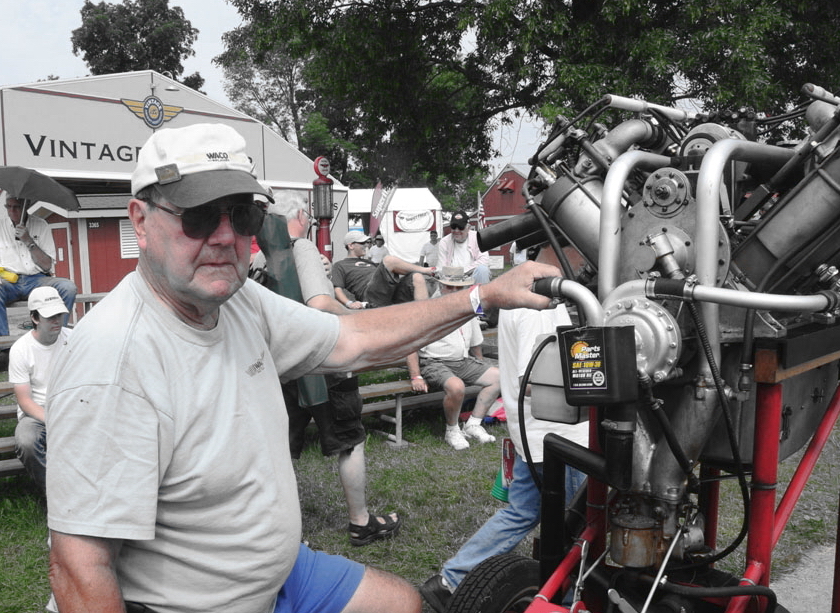
Jim Beisner Runs His Engine
OX5.Curtiss.Engine Link to an OX5 Curtiss Engine History Document by Kimble D. McCutcheon (Used with permission) Credit must be given if you use this article.
This article for the OX5 Aviation Pioneers website is provided with permission, courtesy of Kimble D. McCutcheon via the Aircraft Engine Historical Society Thank you Mr. McCutcheon.
….by Kimble D. McCutcheon
OX-5 was the last in a series of Vee engines designed by Glenn Curtiss that began in 1910. It was a pre-war engine and although obsolete by World War I, it was still put into mass production and was the mainstay of the American wartime training program. There weren’t too many options at the time for the US Army Air Service and the only good domestic trainer available was the Curtiss JN-4 Jenny, designed around the OX-5.
The original OX-5 steel and copper parts were nickel plated, making it a beautiful engine in its classic form. It had an aluminum wet-sump crankcase and separate steel cylinders with brazed copper-nickel alloy (Monel) water jackets. The cylinder heads were attached to the crankcase using X-shaped tie-downs on the top of the head, attached to the block via four long bolts. Fuel was carbureted near the rear of the engine and piped to the cylinders via two T-shaped pipes. The overhead valves were actuated by pull and push rods. There was only enough room for one rocker arm, so the exhaust valve used a normal pushrod that was inside a tubular yoke that pulled the intake valve open. The benefit of this configuration gave the OX-5 overhead valves, which delivered better results in breathing, combustion and power output.
It was a high maintenance engine and the valve mechanism had to be lubricated approximately every five hours. This was unlike the Hispano-Suiza engine where the valve mechanism was entirely enclosed in an oil tight compartment and continuously lubricated. Grease was needed for the rocker arm bushings, engine oil was used for the valve springs and pull down straps, Marvel Mystery oil was used for the valve guides and a spray lubricant was used for the rocker arm rollers. Most airplanes would carry several hours of fuel, so the limiting factor would be the lubrication of the engine.
During cold weather the engine was hard to start. The amount of oil in the crankcase caused a lot of drag on the engine, so it was common practice to drain the oil and store it inside overnight to keep it from thickening.
The OX-5 was rated at 90 hp and turned at a leisurely rate of 1,400 rpm. It was a slow turning engine and the idle speed was an even slower 450 rpm. Despite the engine’s slow speed, it had tremendous torque and would normally turn a large prop on the order of 100 inches. Propellers are more efficient the slower they turn and for the high-drag Curtiss Jenny, a slow turning, large propeller would be more efficient for producing thrust. The technology at the time called for 1,800 rpm as the prudent maximum propeller speed with the absolute racing maximum at 2,000 rpm.
During the war, thousands of OX-5 engines were produced and they saturated the market during the 1920s. In 1917, new Curtiss Jennys were sold to the government for $8,160, but by 1919, a reconditioned Jenny purchased from the Army by Curtiss were selling for $4,000 and OX-5 engines were selling for $1,000. By the mid 1920s, the price of a rebuilt Jenny had dropped to an average price of $2,400. Towards the end of their careers, Jennys could be bought for as little as $500 among private owners, and by 1928, an unused OX-5 could be purchased for a standard price of $250. With such a glut of surplus military aircraft on the market, it was difficult for manufacturers to compete with the production of new aircraft for the civilian market.
While the OX-5 had a reputation as being unreliable, this characterization may not be justified, considering the times. With the glut of aircraft on the market, machines could be purchased so cheaply that many would up in the hands of inexperienced flyers and not maintained properly. There was no type certification or FAA required inspections at the time.
The cooling system was prone to leaking. There were 64 connections for the water system and with so many hoses and connections, inspection and replacement before failure would have been fairly expensive.
Fuel strainers were nonexistent at the time as well as engine air filters and carburetor heat to prevent icing. Carburetor icing wasn’t understood at the time.
The ignition system left something to be desired. There was only a single ignition system and the Dixie magnetos were poorly designed. The engine could be improved with the installation of a Bosch or Splitdorf magneto, but these magnetos were unavailable during the war.
Modern sources claim that if maintained properly, the OX-5 was as reliable as any other engine during this period. In any event, due to the availability of airplanes and engines at such a modest price, many people got the chance to fly that might not otherwise have had the opportunity. One such person was Charles Lindbergh. He owned a Curtiss Jenny powered by a Curtiss OX-5.
|
Specifications: |
|
|
Curtiss OX-5 |
|
|
Date: |
1910 |
|
Cylinders: |
8 |
|
Configuration: |
V, liquid-cooled |
|
Horsepower: |
90 (67 kw) |
|
RPM: |
1,400 |
|
Bore and Stroke: |
4 in. (102 mm) x 5 in. (127 mm) |
|
Displacement: |
503 cu. in. (8.24 liters) |
|
Weight: |
390 lbs. (177 kg) |

You are invited to join our organization of 423 aviation minded members.
We welcome all pilots, mechanics, aviation enthusiasts and aviation historians.
You need not be a pilot to join.
The membership fee is $30.00 per year.
We appreciate any donations added the annual membership fee.
A 30 Minute Home Movie
A short story from Dennis G Yerkey, Gov, Webmaster, Past National President
I learned that a Pittsburgh Clifford Ball Wing member died and that his belongings were being cleaned out and thrown in a dumpster. I performed a dumpster dive and retrieved a VHS tape of 1937 black and white home movies. I had Walmart convert the VHS tape to digital CD. Once digitized, I posted it to our website. We do not know the name of the original photographer.
This post now has 8,387 views.
Dennis G Yerkey, Gov, Webmaster
You do not have to be a pilot or mechanic to join our organization. ………………………………….
1-14-2022


Miss Pittsburgh before mounting at Pittsburgh International Airport
A restoration project by the Pittsburth Institute of Aeronautics instructors and students.
A two year course is now $38,000 plus extras.

D
All American Aviation Page 22 Back Cover All American Aviation Page 21 All American Aviation Page 20 All American Aviation Page 19 All American Aviation Page 18 All American Aviation Page 17 All American Aviation Page 16B All American Aviation Page 16 All American Aviation Page 15 All American Aviation Page 14 All American Aviation Page 13 All American Aviation Page 11B All American Aviation Page 11 All American Aviation Page 10B All American Aviation Page 10 All American Aviation Page 8 All American Aviation Page 7 All American Aviation Page 6 All American Aviation Page 5 All American Aviation Page 4 All American Aviation Page 3 All American Aviation page 2 All American Aviation page 1 All American Aviation Inside Front Cover All American Aviation Front Cover AIR PICK
The Quiet Birdmen is an invitation-only club.
Ancient and Sacred Order of Quiet Birdmen was a source of information about this organization but the webpage seems to have disappeared. The English Wikipedia has a very nice article.
Buehl also belonged to the OX5 Club. Although Buehl came to the United States as a leading expert on the BMW IIIa engine, he later became known for his association with the OX5. Undoubtedly, this came about because the first plane Ernie ever personally owned was powered by an OX5.
Buehl was present at the first general meeting of the OX-5 Club, held at Latrobe Airport on August 27, 1955, and he was among the first to apply for membership. His membership number was 17.


 Ernie checks the radiator cap on his plane at Buehl Field in Eddington, Pa circa early 1960s.

Press_Release_San_FranciscoPress_Release_San_Francisco


Ernie Buehl flying his 1927 Challenger (Fairchild KR-31) over Pennsylvania circa 1950s. The plane was painted red with white wings in those days.
.The OX5 organization would like to thank W.K.Skinner for providing 72 issues of our newsletter to post on our web side.
OX5 Board Members Meeting 4-15-21 - ModifiedOX5 Board Members & Terms 4-21-21 OX5 National Officers And Governors Contact Information 4-21-21
.
 Hello Dennis and OX5 Members,
Laird Aviation Presentation 2017.ppt
Cursor over above box. Click on lower left down arrow to view 72 Laird photos.
===========================================================
A-Swallow-Flies-Home-Edited (1)
Click on this link to download to your computer and wait for photos to load.
A Family Heritage
The following is the story of a very special plane and the people historically bound to it. While every vintage plane has a unique past (and this plane is no exception), in the case of this plane, the story begins with two brothers and a shared passion: The passion of flight.
The plane is a 1927 Swallow OX-5 and the owners of this plane are inexorably and historically tied to it. As such, we want to take this opportunity to explain why this plane is so special. As is often the case with objects of great beauty and craftsmanship, the value of an object has as much to do with its creator, as it does the object itself. To really understand the joy that this plane brings to those who are fortunate enough to be in possession of it today, it is necessary to pull back the clouds of time and look back into the clear blue skies of aviation past when the nation was young and the pioneers of aviation were first making a name for themselves.
One of those pioneers was a man named Laird. Within historical aviation circles, the name of E. M. “Matty” Laird is well known. In the Golden Age of aviation, the name of Laird has a place of honor alongside the pantheon of aviation pioneers like the Wright Brothers, Glen Curtis, Walter Beech, Lloyd Stearman and Clyde Cessna. For those few who know their aviation history (and that number is growing smaller by the day), the Laird name and the many aircraft that bore it represented quality, excellence and pioneering achievement, not to mention speed. And while the name of Matty Laird has continued to be remembered, there was another Laird, his brother, Charles L. Laird.
Charles Laird may not have gone on to the same fame and status as his better-known brother; however his passion for airplanes, figuring out how to build them and how to make them better was no less great. He lived planes. He made a career out of them. From his teenage years to the time he died, he worked on and with aircraft of all kinds. So before we can get into the story of this particular plane, we first need to briefly give the story of this man, because without him, neither this plane nor I would be here today. As the reader might have guessed by the similarity in last names, there is a relationship between Charles and myself. This story, really, is a story about my Great-Grandfather, the plane that he was instrumental in creating, and how this plane, after all these years, came back into the possession of his descendants.
Charles Lawrence Laird’s family was originally from Scotland but they had settled in Birkenhead, England where they had established themselves as prominent shipbuilders in the early 19th Century and eventually became some of Birkenhead’s leading citizens, including John T. Laird becoming the region’s first MP and John Jr. becoming the city’s first mayor. After heading back to Glasgow, in 1871, John Jr. immigrated to America, arriving in New York with his wife, Agnes, and young son, William (Charles’ father).
Charles was born in Chicago in 1899, the younger brother of Matty, who was born in 1896. Matty and Charles both showed an early interest in aviation, along with their older brother William (b. 1892). Matty taught himself how to fly in the vacant fields outside of Chicago (later called Cicero Field) after they built a 12-hp monoplane by themselves in the attic of their home. As Matty was honing his flying skills with the monoplane, Charles and Buck Weaver (Who is the namesake for WACO- Weaver Airplane Co.) began construction on a new plane that would become known as the “Baby-Biplane.” It was this plane that led to the later construction of the “Boneshaker”. It was the “Boneshaker” that first flew a loop with a passenger (Katy Stinson) and went on to become very famous in it’s day as well as helping to make a name for Matty Laird. In the years between 1913 and 1918, Charles continued to learn his craft by working for the likes of Katy and Marjorie Stinson (Where he did maintenance on the Wright Model “B” flyer), Glen Curtis, Standard Aircraft Company and the U.S. Navy.
Charles eventually rejoined his brother with the newly formed “E.M. Laird Airplane Company” in 1918 and was factory supervisor through 1922. During that time period, Matty had become partners with a man named Jake Mollendick, who later would become known as the “Father of Wichita Aviation”, and had moved the company to Wichita, Kansas. In the years between 1920 and 1927, commercial aviation was born and aviation in the United States would be forever changed. Few would have guessed at the time that Wichita would become the center of this pioneering enterprise.
The first plane the Laird’s produced in Wichita became known as the “Swallow” and the rest is aviation history. The Swallow went on to become the first “commercial aircraft” in the U.S. and over the next few years, as Charles was supervising the construction of all the planes and Matty was busy flying them on sales tours, some of America’s most famous aviation pioneers came to learn and/or hone their craft at the E.M. Laird Airplane Company.
Buck Weaver (already mentioned) was hired on as sales manager after the first WACO airplane ever built failed to live up to expectations. Matty also hired on a couple of brothers: Lloyd and Waverly Stearman. Lloyd was a draftsman and Waverly an all-around shop hand. Jake (Mollendick) then hired Walter Beech who flew Swallows and was a good salesman. During these years each of these men would gain experience, knowledge and then, eventually, their own ideas about how to build planes and what kind of planes they wanted to build. It would not be a stretch to say that they learned more than a few things from Charles, who would have been their supervisor.
In 1923, Matty and Jake had a major disagreement and Matty went back to Chicago. It was at this time that the company in Wichita became known as Swallow Manufacturing Co., and Lloyd Stearman updated the design as the “Super Swallow”. Then in 1924, Stearman and Beech left Swallow to form Travel-Air Manufacturing Co. along with Clyde Cessna. Within a few years Beech, Stearman and Cessna would all go their separate ways and each one would contribute something specific and important to the future of aviation.
During his days at Swallow, Charles (along with Lloyd Stearman) had designed and built a twin-engine (OX-5) 7- passenger airliner called the “Transport.” After it was refitted with a more powerful Liberty engine, Walter Beech made a forced landing in the plane (renamed the “Limousine”) and it had to be scrapped. This led to a falling out between brothers and Charles left the company in1922. In 1925 however, Jake lured Charles back to Swallow.
In his second stint with Swallow, Charles designed the “New” Swallow and some were fitted with a J-6 (225 hp. Whirlwind). It performed so well that Varney Airlines purchased several of them. Varney flew passengers and mail from Elko, Nevada to Pasco, Washington. Eventually, Varney Airlines became known as United Airlines.
After Jake refused payment for design services, Charles left Swallow in late 1927. Once he left Swallow, he formed his own Laird Manufacturing Corporation. Between 1927 and 1929, Charles designed and built his own “Laird Specials” as well as a cabin passenger plane called the “Whippoorwill”. After the crash of the stock market in 1929, Charles was wiped out, but not before paying back all of his stockholders.
Charles returned to Chicago where he designed and built custom planes from 1930 to 1932. From 1933-1945 he worked for major aircraft corporations like Northrop, Consolidated and North American where he was eventually given the task of final inspection on many types of aircraft because of his overall knowledge and expertise. He served as Chief of Final Inspection for North American throughout the duration of WWII. The 80-100 hour workweeks during the War had taken their toll physically and he didn’t work much for a couple of years. Then, in 1950, when the Korean War broke out, he went to work for the Air Force at George Air Force Base (Adelanto, California) as Chief Inspector until his death in 1967.
It is likely that he worked on the very Swallow that the family now enjoys. Even if he didn’t work on it physically, it exists today because of his contributions and the contributions of so many other men who would go on to shape civil aviation, as we know it. We do know that this plane was completed in December of 1927; just 2 months after Charles left Swallow. So, it is with a profound sense of history and gratitude to those who worked to get this plane back in the air, that we are able to enjoy flying this piece of aviation Americana.
We would like to thank Will Laird for permission to post his great article and presentation about his Father Chuck Laird and the family aviation history.
OX5 Aviation Pioneers
1927 Swallow OX-5 (NC979)
|
………^
Down Arrow to move to next page.
https://ox5.org/wp-content/uploads/OX5-FROM-BOOK-Combined-A.pdf
January 1, 2026
Greg Gaynor, 2025 National President
1350 Cherry Creek Road
Sparta, TN 38583
931-252-0397
.
Patty Wagner, Treasurer
3233 South Kessler Road
West Milton, OH 45383
937-999-9594
James Beisner, National Governor
3730 Monroe Concord Rd.
Troy, Ohio 45373-9294
937-554-9294
1901 Hwy. 17-92, Lot 106 Winter Address
Lake Alfred, FL 33850-3185
…..
Sam Meek, National Governor
1008 Harold Drive
Nashville, TN 37217
615-310-7596
…..
Dennis G Yerkey, National Governor & Webmaster
4061 Rustic Woods Drive
Jefferson Hills, Pa 15025
Note eMail address change
412-445-3940
Russ Berry, Gov
7425 S Kessler Frederick Road
West Milton, Ohio 45383
berrygoodwine@yahoo.com
.
Ernest H. Buehl
Source: Rosanna Buehl, Granddaughter
Latrobe 1955
The OX5 Aviation Pioneers started here.


By Rich Wilbur, Past President
On Sat, Sep 21, 2019 at 2:29 PM Jason Bowling <kb8rnu@gmail.com> wrote:Good day:
My great uncle, Joseph Bergling, was apparently a member of yours, and an aviation pioneer. I’ve been going through some of his old papers, and one was a speech he gave to one of your gatherings.
He also was the test pilot for the Taylor McDaniels rubber inflatable glider. I’ve written two articles that you and your members may find interesting.The first link includes the text of his speech to your organization, and the second is an account of the rubber inflatable plane.
I send them to you in hopes that you and your members may find them interesting. Please feel free to share these links however they might be of use to you.
LINKS
https://shortcircuitsandinfiniteloops.blogspot.com/2019/09/the-aviation-writing-of-joseph-c.
htmlhttps://shortcircuitsandinfiniteloops.blogspot.com/2019/08/joseph-c-bergling-and-taylor-mcdaniels.html
Sincerely,
Jason Bowling
Thank you Jason. Ox5 Aviation Pioneers
OX5AviationPioneersSpeech-JoeBergling


The goal of Aviation Cadets is to launch students into a lifelong path of high achievement and fulfillment. The students are motivated and excited to see their names on a plaque in the museum next to their handiwork. If you or someone you know is interested in WACO Aviation Cadets, please call the museum at 335-9226 or Visit the LEARN tab at www.wacoairmuseum.org.
The first three photos in front of the Hall of Fame wall are by the Curtiss Wing.
Remainder of photos courtesy of Don Voland, Nat Sec

Mr and Mrs Wayne Gordon

Mr & Mrs Jim Beisner

The late Jim Poel’s Brother, Chuck and Jim’s Daughter.

Group Photo Oct 13, 2018


r. Rich Wilbur


The organizational meeting and first convention was held at Latrobe, Pa Airport August 27, 1955. This picture is Williamsport, Pa 1956

First National Convention Sept 8, 1956 Willamsport, Pa


Hi,
My grandfather, Lloyd C. Pownell, was an airplane mechanic and pilot.
His name is listed on your 1957 membership roster (Lemoyne, PA).
He was an original member of the OX-5 Club and often flew a Curtiss “Jenny’.
I’ve attached a few photos. Feel free to post hem if you like. My mom is
in one of the photos. Her name was Evalyn. She passed away last year at
age 95.
Cheers,
Tom Samuel


Courtesy Glenn Curtiss Wing – Hammondsport, NY

Owned by the Cliff Ball Wing of Pittsburgh, PA

Now on display at the Florida Clubhouse.
President Richard Wilbur has created a FaceBook page for the OX5 Aviation Pioneers. FaceBook has become an extremely popular form of communication and information. We think the page will help spread the word of our organization.
We will be posting news and current information on the page.
Do check it out at this link.
https://www.facebook.com/OX5AviationPioneers/
Home Page of Captain Billy Walker
Greetings! If deemed appropriate, I’m hopeful you will show a link to my website. It is an aviation website with, presently, some forty four stories, videos, along with photos.
Many references to the OX-5 Aviation Pioneer group of which I am the former president of the Arizona Chapter. My father, Pic Walker was an early member and my mother as well. For a long time Mom was the Secretary/Treasure of the Arizona Chapter.

This Limited Edition book was Published and copyrighted by the OX5 in 1985.
It contains hundreds of photos and early member biographies.
Owned and scanned for posting by Dennis G. Yerkey, Gov & Webmaster, you will not find a better source of information in print. Permission is granted to download and print.
Forest Arden was the chief flight mechanic of a B-29 stationed at Tinian Island. His aircraft was parked nearby to the Enola Gay and he watched the loading procedure of the first Atomic Bomb. He said that security was strictly enforced and no one was allowed to approach to within 100 yards! Few had any inkling of what about to occur. Everyone was astounded at the sudden end of World War II.
.
6-10-2016
From: John Gaertner
Hello James,
I received my Spring News letter this morning. Thanks!
I am attaching some details that I hope will be helpful to others in the OX5 club? I would like to see if they could be posted in the next newsletter?
We are making and selling new rubber couplings for the Berling Magneto. Many people find all they have are some broken , rubber pieces when they go to install their Berling mags. This is a one piece coupling that fits perfectly in the coupling housing and makes re-assembly much easier. They are available from us, at Blue Swallow Aircraft, LLC.
.

Second, I am attaching a PDF file of the OX5 Engine Cradle we make and other people can to, to transport our engines. It is straight forward in construction and can even be used for some basic service work.
We have assembled a new OX5 engine starter system after a great deal of trials and tribulations with the Berling Magneto on one of our engines. It uses a Continental Motors Starter Vibrator and a lithium Ion 12V 8000mA battery the size of a smart phone. Easy to install and remove from the plane. It works perfectly with the Berling Magneto points.
I noted that the link on the OX5 web site to our web site no longer works. We have completely redone our web site in order to better serve our customers. They proper link to the OX5 engine pages is: https://www.blueswallowaircraft.com/New-OX5-Engine-Project-1.html (Fixed by Webmaster)
Thank you,
John Gaertner
Featuring– Biographies of the Pioneers: (Charles B. “Charlie” Carroll, James DeWitt Hill, Carl Strickler, Raymond “Pappy” Elder, Lloyd Santmyer, Clyde Hauger, Dave Patterson, Lou Strickler, Russ Brinkley, Frank Fox, Joe Reedy, Earl Metzler, George Allen, Elmer Ashbaugh, Clifford Ball, D. Barr Peat, Ken Scholter, Dr Lytle Adams. Airports: Longview Flying Field, J.D. Hill Airport, Latrobe Municipal Airport, Latrobe-Westmoreland Airport, Westmoreland County Airport, Bettis Field (Mckeesport, PA), Rodgers Field (Aspinwall, PA), Pittsburgh-Greensburg Airport. Events:All American Aviation Air Mail Pick-Up, Path of Eagle, Pennsylvania Airlines, Pennsylvania Central Airlines, Founding of the OX5 Pioneers of America.

Bettis Field, now Allegheny Count Airport
Courtesy Cliff Ball Wing of Western Pennsylvania
Printed winter 1993/1994
p 155 to 182

“Miss Pittsburgh” is an OX-5 powered 1927 Waco 9 airplane.
After being lost for many years, the airplane was rediscovered in 1993 by OX-5 pioneers and returned to Pittsburgh, where it was carefully refurbished by Pittsburgh Institute of Aeronautics.


This is about All American Aviation Air Mail pick up service starting in 1941.
Allegheny County Airport, Pittsburgh, PA.
This booklet copyrighted in 1946 with photos from the Army Air Force.
Note: There are original printing errors such as missing pages and wrong page numbers.
From the Cliff Ball Wing archives, Pittsburgh, Pa.
All American Aviation Front Cover
All American Aviation Inside Front Cover
All American Aviation Page 10B
All American Aviation Page 11B
All American Aviation Page 16B
All American Aviation Page 22 Back Cover
All American Aviation Routes A
All American Aviation Routes B
.
Dennis Harbin, owner of Rag Bag Aero Works, Inc., has given the OX5 Aviation Pioneers permission to embed his blog postings on our web site.
These blogs and movies are of various restoration items and projects that he is doing in his shop. They are easy to read and include abundant photos of the work in progress.
Note: Dennis has records of 130 of the NINEs that were registered.
Do click on the links below for some great information on restoration.
This is a link to a great airplane photo site: https://1000aircraftphotos.com/
1000aircraftphotos.com got its start in 1998 hosted on Homestead.com, created by Ron Dupas, of Depoe Bay, Oregon, US. It was called “Aviationphotos” at that time. The images came from Ron’s collection of several thousand photos that he amassed between the late 1950’s and early 1970’s. The majority of the photos were taken by Ron in countless trips to airports all over the USA and Canada, and others came from relatives and companies.
Aviationphotos soon grew in size to a point that the limit of free space was reached, so the next step, in 2000, was to register a name for the site and host it at a “real” web hosting company. Offers began to come in from web site visitors to supply the web site with additional photos. You can see them in the Contributors and Collections section of the web site. Most of the photos on the web site come from contributors. Visitors also contribute remarks and stories about the photos. Had it been forseen that the site would far surpass the number of Ron’s own photos, the site would have been named 100000aircraftphotos.com
In 2003 Johan Visschedijk of the Netherlands partnered with Ron to add basic information about the aircraft types represented on the web site, and to ensure accuracy of aircraft identifications. Johan’s photo collection is also on 1000aircraftphotos.com.
1000aircraftphotos.com has achieved a level of success far exceeding what was thought possible. It is a certainty that this could not have happened without the contributions made by many aviation enthusiasts who supply photos and remarks. Keep them coming! Permission was granted to link to this site.
11-12-2014
Greetings!
I am a former president of the Arizona OX-5’ers. I have been out of the picture for several years as the Arizona bunch no longer meets largely due to no leadership along with so few members still living.
However, I have been working with my friend, Ed Newberg, on getting his 1928 Travelair 2000 flying.
Yesterday, success! Here are a few photos of NC-4848:


The flight was at P-19 “Stellar Airpark” Chandler, Arizona.
Powered by the ubiquitous 1918 OX-5, it swings an Ole Fehlin prop and flies at the speed of smell !
I flew chase in Kurt Gearhart’s Stearman (955) while Kurt made these masterful shots.
Blue Skies & Tailwinds…
Billy Walker
(480) 773-2823


Memphis Belle at Pittsburgh, Pa.


This page is the most visited page on the OX5 web site. I suspect that people marvel at Dean’s beautiful engine restorations. He turns a truckload of parts into a thing of beauty. Dean was born 11-14-1919. Webmaster


Aviation artwork by OX5 Cliff Ball Wing member Eddie Harris.
https://www.eddie-harris-artist.com/
Permission was granted for OX5 use.
 Aviation artwork by OX5 Cliff Ball Wing member Eddie Harris.


Father of Pat Griswald
Larry Bartell was a former OX5 National Governor from the Wisconsin wing.
Larry Bartell was born in Whitefish Bay, a suburb of Milwaukee, on March 19th, 1914. He moved with his family to Waukesha County , in the Genesee Town area west of Milwaukee, when he was 8 years old and never left the area. He held many jobs in his young life, such as truck driver, crane operator, bull dozer operator and mechanic. He married Evelyn Ernst in 1935 and bought a 135 acre farm where he raised outstanding Guernsey dairy herds, 3 sons and 2 daughters. Larry was the type of person who appreciated what he had and gave back to his community the rest of his life. He served as supervisor and town chairman of Genesee for many years and on the local Kettle Moraine School Board for 14 years.
Larry’s longest tenure of service came on the Waukesha County Board. He used this position to spearhead the committee on the Waukesha County Airport Affairs and was a key member of the State of Wisconsin Airport Committee. Bartell was integral in cementing Waukesha County’s first airport committee for the oversight of the Waukesha County Airport Operations.
If Larry seemed heavily involved in aviation that is because airplanes to him were much more than a flight of fancy. He learned to fly without his family’s knowledge after Sunday mass in 1953 with friends who had a small airstrip near the Town of Genesee. He had taken a ride with a pilot friend, Bob Vandenberg, and after several more rides with Vandenberg, Larry was allowed to take the controls and he was fascinated. About a month later in October 1953, an acquaintance offered to sell him a 1946 Taylorcraft for $750, whereas Larry took 3 cows to the Milwaukee market to sell them and on the way home stopped and bought his first plane, the Taylorcraft. Eventually, he logged 500 hours on that plane. It took somewhat more persuasion for his wife Evelyn that they needed an airplane since she wanted a new rug for the living room, and besides she said he couldn’t even fly it!
He took flying lessons at two different airports near Waukesha and earned his private pilot’s license soon after. Eventually, he ended getting his charter and commercial license and flew all over the U.S. His big project after getting his private pilot’s license was to construct a 1500 ft. runway on his farm and a hangar for the plane. In April of 1957, he bought a 4-place Stinson and logged 328 hrs. on it. In February of 1962, he bought his favorite plane of all, a 1947 V-Tail 35 Bonanza which he flew until 2006 at age 92. His last purchase was a KitFox from a friend in 1997. In his lifetime, he introduced roughly 300 children and some adults to the excitement of flying by giving free rides in his various planes. Many went on to be private and commercial pilots.
He was an active member of the EAA, A.O.P.A., Waukesha Aviation Club, Flying Farmers, Midwest Antique Airplane Club, Racine Breakfast Club, Octagenarian Flying Club Society, Bonanza Society Club and the OX5 Pioneers, where every year you would find Larry and other members of the Wisconsin Wing located in a tent at the Oshkosh Air Venture explaining the operation and the history of the static display engine owned by club member Chuck Heide. Outside his aviation clubs, he belonged to the local volunteer fire department, the Delafield-Summit Lions Club and the local 4-H Club where he was the horsemanship leader for many years. He also served as President of the Wisconsin Wing of the OX5 and was a national governor for several years of the OX5 organization. His daughter and son-in-law, Dennis and Pat Griswold, are continuing the OX5 booth each year at Air Venture, only now it is in the Vintage Building on the grounds at Oshkosh.
It was due to his passion and work that he did that he received an award for Outstanding Achievement in Aviation from the Wisconsin Department of Transportation, Bureau of Aeronautics. He received the award in 2003 on the 100th anniversary of the inaugural flight of the Wright Brothers. On May 6, 2005, Larry was inducted into the EAA Southeastern Wisconsin Aviation Hall of Fame.
Even while busy farming, he took time for and received his real estate license and his real estate appraisal license. His many hobbies were hunting, snowmobiling, playing the button box, according and drums. He was the best dancer and sheepshead player. One of his many trips in his V-Tail Bonanza was to fly as far as Montana with a friend and then take a commercial plane to Alaska to go Caribou hunting. He shot a very large caribou and brought back the antlers lodged in the V-Tail. He said they “just fit”.
Among Larry’s many friends were neighbors, Alfred Lunt and Lynn Fontaine, the Broadway actors, and Larry was always proud to deliver a load of manure for Alfred’s garden each spring. Alfred always wrote a note thanking him for the “delicious manure”.
His wife, Evelyn passed away in 1979 and a son died in 1975. Larry left this earth for the blue skies on April 8, 2008 and joined his good aviation friends, Dean and Dale Crites, Charlie Dewey, Steve Whitman, Bob Ladd and many others. Larry had 22 grandchildren, 19 great-grandchildren, and 4 great-great grandchildren.


Robert G Lock
Link to: RANDOM THOUGHTS-Mentors and Friends
Link to the book.
Command-Aire & Albert Vollmecke
An excellent book by Robert G. Lock about the Arkansas Aircraft Corp and Albert Vollmecke.
A total of approximately 140 OX-5 powered Command-Aire model 3C3 ships including the model 3C3-T were produced by the Little Rock factory before declaring bankruptcy in the fall of 1931. The first model 3C3 ship was C-3790, serial number 500 and the last was NC745W, serial number 655.
Used with permission of the author.
Give credit if used in any way.
158 pages 34,340 words
It is a long file, so give it time to load.
10-23-2013
From: Dennis G. Yerkey, ID 22023 Gov, Past Pres & Webmaster
The following discussion was introduced into the the minutes of the 2013 Board Meeting by Gov Donald Voland.
“We should be considering establishing a program (method) to provide for continuity with our web site as it is a vital part of our overall operation. It really has become our digital records center for all members as well as for potential new members. A contingency plan to protect this link in our communication system is very important” Don Voland.
Be advised that as a back-up measure, Dennis G Yerkey, Webmaster, has turned over all particulars concerning the OX5.org website to Gov Donald Voland, Sec.
This includes:
Domain ownership information OX5.org
Hosting information, account numbers and passwords GoDaddy
All renewal dates and the costs to renew
WordPress log on address and passwords WordPress
Official worldwide website registration information Whois
With this information in hand, Gov Voland would be able to assume control of the Website to maintain continuity. A person with website knowledge could then easily maintain the site using a common program called ‘WordPress’.
Sincerely,
Dennis G Yerkey – 22023
Nat Gov-Past Pres-Webmaster
VP/Sec of the Cliff Ball Wing-Pittsburgh, PA

The First Wing


Double click on an image to enlarge.
The Aero Club of Pa held a fly in with the destination being Eagles Mere Airport.
Eagles Mere is a Wing of the OX5 Aviation Pioneers
Photos submitted by Robert Dant, VP Print-Web-Photos
Below is the link to the Gen Jack R Cram article.
Gen Jack R Cram article/biography
Permission was granted by Cal Tayor to the OX5 Aviation Pioneers to use his article for our website and newsletter. 8-7-2013
|
Tilton Article from Sport Aviation 1984


Photos of Dean Tilto’s OX5 engine project.
This is a link to a very detailed 15 page OX5 engine article by Sandy Skinner
Used with permission of the author on 3-29-2013. Credit must be give if used.
This article appeared in the Vol. 4 No. 4 Fall 2005 issue of the Aircraft Engine Historical Society, Inc., a 501 (c)(3) from Huntsville, AL 35816
From Wikipedia, the free encyclopedia
Edgar Allen “Pete” Goff, Jr. (December 12, 1896 – February 11, 1989) was an Air Force colonel and jet fighter pilot.[1] He was a member of the Early Birds of Aviation, an organization made up of pilots who flew before December 17, 1916. In service, Pete spent 13 years on active duty and 36 additional years as a reserve officer.
He was born on December 12, 1896 to Edgar Allen Goff, Sr. in Battle Creek, Michigan.
Pete built and flew his first glider in January, 1912 when he was in high school in Battle Creek, Michigan. With the Air Force, he progressed to a fully qualified jet fighter pilot, instrument card rated. He also received a license as a helicopter pilot.
He made his first recorded flight in June, 1915.
He joined the Aeronautical Division, U.S. Signal Corps in January, 1917, and after receiving his ground and primary flight training, he took advanced training at Kelly Field and was commissioned a Second lieutenant in the Officers Reserve Corps in May, 1919.
For several years Pete operated a sales, service, school and taxi business at Battle Creek, and was employed by Stinson and Verville Aircraft Company. He also flew for a few months as air mail pilot. From 1937 to 1942 he was employed by the Bureau of Air Commerce at Pittsburgh, leaving his position as Senior Aeronautical Inspector to return to active duty in the Air Force. He had a total of over 11,000 hours of civilian flying and 6,000 hours of recorded military flight.
On January 14, 1957 Pete’s fellow officers and many of his Early Bird friends honored him at a cocktail hour and dinner at the Officer’s Club at Wright-Patterson AFB where Pete was stationed. Guest speaker was Brigadier General Leslie Mulzer, and Pete’s flying career from pushers to jets was recalled in fond tribute to a man who has contributed greatly to the development of aviation.
After retirement, he was active with the Link Aviation of Binghamton, New York.
He retired from active military service on January 31, 1957.
He died on February 11, 1989 in Edgewater, Maryland of respiratory failure.[2]
“Edgar Allen “Pete” Goff, Jr.”. Early Aviators. Retrieved 2011-05-31. “Lt. Co. Edgar A. Goff, Jr., who made his first recorded flight in June, 1915 and who has flown continuously ever since, progressing from pushers to jets, retired from active military service on January 31, 1957. “Pete”, as he is known to his many friends, was the last member of the Early Birds still on active duty with the Air Force at the time of his retirement. Although he has retired from Uncles Sam’s forces, he will maintain his active interest in aviation. …”
“Edgar A. Goff, Jr.”. Washington Post. February 15, 1989. “Edgar A. Goff, Jr., 92 a retired Air Force lieutenant colonel who also had owned and operated an advertising agency in Washington died of respiratory failure .”
2013
Kathi Latson wrote:
Dear Mr. Voland,
Greetings from Spencer, NY!
I purchased a set of vintage OX5 Aviation Pioneer coasters (from 1976!) off of eBay. I am a 52 year old lady who has always loved flying and sometimes gets to have a lesson here and there, but I thought the coasters were cool looking. After I received them, I decided to check the internet to find out more about the OX5 engines and your organization. I wanted to compliment you on your website. :) It was very educational and interesting. I come from a family of non-flyers, so I always envy those who have relatives that love aviation or have actually been blessed to fly these wonderful planes. Keep up the good work!
Many thanks,
Kathi Latson
Frank _Chilli_ Miller OX5 Pioneer3-15-2013
Mr. Beisner,
I am attaching a “life story” of a gentleman I met years ago that belonged to my church.
Unfortunately, he has since passed away, but I would like to send you the transcript that
was prepared. (34 pages)
I loved his story.
In fact, as he was dictating it for me, he giggled all through it!
You pioneers are dare devils!
Thanks,
Jane McConnell


| 11S1 | 270421 | Cleveland OH | STC | Lovejoy & Noyes | $7.50 |
| 11S2 | 270421 | Youngstown OH | STC | Moltrup & Noyes | $18.00 |
| 11N3 | 270421 | McKeesport PA | STC | Moltrup & Noyes | $9.00 |
| 11N4 | 270421 | Pittsburgh PA | STC | Moltrup & Noyes | $7.50 |
| 11N2 | 270421 | Youngstown OH | STC | Noyes | $15.00 |
| R11N6 | 310608 | to Akron OH by southbound plane | STC | $6.00 | |
| 11S5 | 310608 | Akron OH | STC | LV Scriggins | $4.50 |
| R11S6 | 310608 | to Akron OH by northbound plane | STC | $6.00 | |
| 11N5 | 310608 | Akron OH | STC | RL Baker | $7.50 |
| 11E7 | 310608 | Pittsburgh PA | STC | LV Scroggins | $18.75 |
| 11E7F | 310608 | Pittsburgh PA | STC | LV Scroggins | $37.50 |
| 11E8 | 310608 | McKeesport PA | STC | Ed Couples | $26.25 |
| 11W9 | 310608 | Washington DC | STC | RL Baker | $5.25 |

1911 | Washington , D.C. “Senorita Lenore Riviera with Antony Jannus in Rex Smith aeroplane”
| Rex Smith Biplane | |
|---|---|
| Role | Biplane |
| National origin | United States of America |
| Manufacturer | Rex Smith Aeroplane Company |
| First flight | 1910 |
| Introduction | 1910 |
| Developed from | Curtiss Pusher |
The Rex Smith Biplane was a pioneering biplane based mostly on designs of Glen Curtiss. It was built and demonstrated at College Park, Maryland at the same airfield that the Wright Brothers and Curtiss demonstrated their aircraft for the U.S. Army Signal Corps just North of Washington D.C
|
|
At a 1911 display in Washington D.C., a large crowd gathered to watch the motor started indoors, kicking dust throughout the building. On April 13, the biplane demonstrated wireless air-to-ground communications at College Park. On April 15, test pilot Tony Jannus attempted a take off from the Potomac River with new pontoons attached to the landing skids. The plane plowed into the water, nearly drowning Jannus. By the end of the year, the aircraft had demonstrated 137 flights, including takeoffs and landings during snowstorms.
A aircraft was developed with an airfoil that tapered from four feet thick to nearly flat at the wingtips. The aircraft used wing warping tips rather than ailerons.[3] It was tested with a Hall-Scott engine by test pilot Paul Peck. A Berliner Rotary was also considered for the design.[4]
The Bernhard Klein collection.
A great collection of Aircraft photos.
https://1000aircraftphotos.com/index.html
https://www.dmairfield.org/Collections/Klein%20Collection/Civil/Private/index.html
https://1000aircraftphotos.com/Contributions/KleinBernhard/KleinBernhard.htm

Commercial Aviation Took Off in Pittsburgh by Adam Lynch
Not all the thousands of people who regularly pass beneath her glance up, but occasionally, one will stop for a better look. She hangs from the ceiling of the Landside Terminal at Pittsburgh International Airport with her name, Miss Pittsburgh, written on her nose. Further back, on the fuselage of this very old airplane, are the words U.S. MAIL.
Once, she represented the very beginnings of successful, commercial aviation in this part of the country. It is no exaggeration to claim that this 85-year-old, single-engine, canvas-covered Waco 9, along with her identical, open cockpit hangar mates Miss Youngstown and Miss McKeesport, were the planes that helped launch an industry. Two of today’s best-known airlines—US Airways and United Airlines—trace their growing years to Pittsburgh.
It took a rare combination of personalities and events starting in the early 1920s to create the air industry we know now. Two local men with an intense interest in aviation came together at the right time. Clifford Ball, a McKeesport automobile dealer, had been fascinated by aerial demonstrations at a field on a hill above Dravosburg, across the Monongahela River from McKeesport. The field was 40 acres owned by D. Barr Peat, who invited pilots to come and entertain folks who hardly knew what airplanes looked like.
In 1924, Ball mortgaged everything, borrowed the rest, and bought the property from Peat for $35,000. He erected a building that was a combination machine shop and hot dog stand. Peat, now a partner in the operation, cut down trees, ran the tractor, and molded the property into what they first called Pittsburgh/McKeesport Airport and later simply Bettis Field, in honor of World War I army pilot Lt. Cyrus Bettis. (The site is now the Bettis Westinghouse Atomic Facility.)
With no clear plan, activities at the airport were limited. They had two old airplanes, and offered rides for $5, flying lessons, parachute jumps, fireworks launched from airplanes, and hot dogs. They charged visitors 25 cents to watch the planes cavort in the air. Ball’s secretary, Helen Stinner, served as gatekeeper and ticket taker and was surprised that a good day could produce $500. However, both men wanted something more than running a weekend flying circus. A political connection of Ball’s would pay off in dramatic fashion.
The advent of airmail
U.S. Congressman Melville “Clyde” Kelly had published newspapers in McKeesport and Braddock. Popular and ambitious, he served two terms in the Pennsylvania Assembly, and in 1917 won election to the U.S. House of Representatives, where he chaired the Post Office committee. With help from the influential Aero Club of Pittsburgh and the Pennsylvania Chamber of Commerce, Ball convinced his friend Kelly to sponsor federal legislation changing the delivery of airmail.
Earlier airmail attempts had proved inefficient and dangerous. Of the initial 40 Army Air Corps pilots involved, three died in crashes in 1919 and nine more in 1922. Limited pilot experience, dangerous weather, and flying at night over unfamiliar territory were to blame, as was the “mail must go through” mentality. When the “Kelly Airmail Act” became law in 1925, not one Pennsylvania city had airmail delivery.
The new law authorized the federal government for the first time to “designate airmail routes and to contract with private parties for their operation.” Historians call it “the cornerstone of the modern air carrier industry.” Ball received airmail route No. 11—the 127-mile flight between Pittsburgh and Cleveland. The first official flight took off from Bettis Field at noon, April 21, 1927, a few months before Charles Lindbergh crossed the Atlantic.
Purchasing airplanes and meeting growing payroll and operational costs were expensive, but one flight in a Waco 9 loaded with mail bags could return as much as $1,500. Ball’s pilots included men with such marvelous names as Curly Lovejoy, Merle Moltrop and Dewey Noyes. Ball called his airline Path of the Eagle and soon began carrying passengers to a growing number of cities. His first passenger was vaudeville entertainer Will Rogers, who paid $20 for a Miss Pittsburgh flight to Cleveland, sitting on a pile of mail bags.
It was about this time that Helen Stinner became a one-person public relations dynamo. She visited post offices in McKeesport, Youngstown and Pittsburgh, set up a portable booth, chatted with postal patrons, and explained how they could send airmail letters for 10 cents an ounce. By the end of 1927, Ball’s little airline had carried almost 10 tons, and in the next two years, it soared past 91 tons. Ball purchased some Fairchild FC-2, four-person, closed-cabin aircraft and in August 1929 began the first scheduled passenger service to Washington from the west. Pittsburgh-area businessmen, noting Ball’s success, began forming new airline companies to compete in the growing industry.
A new industry
Enter prominent Pittsburgh attorney George R. Hann. In 1928, he arranged a meeting with A.L. Humphrey, president of Westinghouse Airbrake Corp., to discuss commercial aviation. Hann brought in University of Pittsburgh professor Bedell Monro and his brother-in-law Fred Crawford. Together, they attracted more than $1 million in investments and started the Pittsburgh Aviation Industries Corp. (PAIC). Envisioning a national airline, they soon combined with Transcontinental & Western Air (T&WA, which became TWA). PAIC got 5 percent of the stock in the new creation, which they called Pennsylvania Airlines (PAL). After carrying 7,000 passengers in 1931, they purchased 12 Tri-Motor Ford Airliners, and by 1933 had 14,000 passengers.
The economic engine helping to drive the business was the profitable airmail contract. In 1930, Ball, citing what he called “economic and political pressure,” reluctantly sold his airline interest to PAIC for $130,000. His valuable airmail contract was part of the deal. He was given a position as vice president of “operations,” but soon quit. He and Helen Stinner, now married, went to Florida for six lazy months to regroup.
Meanwhile, the airline industry was about to weather a series of disturbing events. Amid charges (some valid) of industry-wide fraud and corruption, President Roosevelt cancelled all airmail contracts in February 1934. The Air Corps was again called on to deliver airmail, but with the same handicaps and tragic results of 1919 and 1920. In the first week, five pilots died. Of 26 ensuing crashes, 12 were fatal. The government retrenched, announcing that all airmail contracts would be rebid. Previous contractors were barred from the process, so PAL stockholders simply reorganized the company, calling it Pennsylvania Airlines and Transport Co. Heated competition and confusing name changes became industry norms.
Pittsburgher Jim Condon and brothers John H. and Richard W. Coulter created Central Airlines. With the reorganized PAL and Central flying similar routes out of the new Allegheny County Airport, the infighting became bitter. Fares were cut and cut again. Each company accused the other of stealing passengers when departure times coincided. Neither made profits, so the obvious solution was a merger, and in 1936, Pennsylvania Central Airlines (PCA) came to be. By the end of 1938, the airline had carried 85,000 passengers.
PCA replaced its fleet of 10 passenger Boeing 247Ds with state-of-the art DC-3s, the iconic airplane that made commercial flying not only more profitable but safer and faster. It moved its headquarters to Washington National Airport, but economic pressures continued. New management changed the name to Capital Airlines in 1946 and enjoyed several years of success, becoming the fifth-largest domestic carrier. The wild series of mergers continued, culminating in the 1961 merger of Capital into United Airlines, creating the world’s largest commercial airline with a route network spanning the country. A relative stability followed, which ended only with the terrorist attack of 2001, from which the industry has never fully recovered.
Ball’s legacy
Cliff Ball must have watched western Pennsylvania’s dizzying aviation history with a degree of bitter amusement. Although without an airline of his own, he came home to play a huge leadership role in the local industry. During World War II, he was director of Graham Aviation in Butler, which trained Air Corps pilots. He became the first superintendent of the Greater Pittsburgh Airport when it opened in 1952, later serving as director of the Allegheny County Department of Aviation until 1958. He long presided over the prestigious Aero Club of Pittsburgh, whose membership included not just pilots but the captains of many local industries. Despite his influence, he remained humble. Ball, who died in 1972, never acquired a pilot’s license, but his wife Helen did. Ever an active aviation enthusiast, she counted among her friends such luminaries as Lindbergh and Amelia Earhart. She often flew to Washington to visit with Ernie Pyle, who was an aviation writer there before he became famous as a roving World War II newspaper columnist.
The grande dame returns

In 1960, Kingston, N.Y. businessman Marty Horan saw an old airplane being used for advertising at Florida’s Tamiami Airport. It was Miss Pittsburgh. Horan bought the aircraft and flew her for fun for several years. Later, he had Miss Pittsburgh dismantled and shipped to the Old Rhinebeck Aerodrome in Rhinebeck, N.Y. for use in vintage airplane air shows. Apparently, however, she was never reassembled.
In 1992, Frank Gustafson of Swissvale spotted the letters “BURGH” on a piece of an old airplane amid odds and ends in a corner of a hangar at Rhinebeck. He then found the wingless fuselage, still on wheels. Gustafson told former airline pilot Jim Taylor of Bethel Park what he had seen, and word spread. Soon, local aviation enthusiasts combined to bring what was left of Miss Pittsburgh back home, and in 2000, Horan agreed to sell the old plane to the Historical Society of Western Pennsylvania for $62,000.
Kent George, then the Allegheny County Airport Authority director, committed $25,000 to a fundraising campaign launched by local aviation groups. The two-year restoration of Miss Pittsburgh began, manned by experts, students and volunteers alike.
Of the airplanes that carried the early mail in this region, Miss McKeesport resides in a Columbus, Ohio museum. Miss Youngstown has simply disappeared. But on April 28, 1995, a bright nylon covering was pulled away at the Pittsburgh International Airport, and there, hanging from the ceiling, was Miss Pittsburgh.
She’s in the air again in the city where she helped launch commercial aviation. Outside, sleek, loud, wide-bodied jetliners climb steeply into the sky while little, twin-winged Miss Pittsburgh hangs silently, frozen in time. 
……………………………………………………………………………………………………………………………………
Adam Lynch Adam is a retired Pittsburgh WTAE news anchor/reporter who, after some 40 years of broadcasting, launched a freelance writing career. Mostly, he writes about historic or military aviation events. When not writing, he might be found fishing, photographing or bird watching. Adam lives with his wife, Ellie, in Monroeville, where the couple recently celebrated their 51st wedding anniversary.

1910

1929 Boston
https://www.lesliejonesphotography.com/subject-series/aviation/46
Click on the above link to view some great aviation photos by Leslie Jones that are now in the Boston Public Library.
Click on an image tag in the right box. example biplanes
Biplane photos will then appear if Jones took a picture in the 20s or 30s.
He snapped 40,000 pictures (mostly glass negatives) of which 660 were aviation related.
DGY
Lindbergh’s airplane, the Spirit of St. Louis, was unique. Dubbed a “flying gas tank,” the plane could hold more than 450 gallons of fuel. It had a 223 HP radial engine, a 45-foot wingspan and got about 10 miles to a gallon, giving it a range of 4,200 miles. The plane, engine and pilot weighed only 2,500 pounds, but a full load of gas weighed 2,700 pounds, more than doubling the weight of the plane. To keep the weight down, Lindbergh left off the radios, the brakes, the pilot’s parachute and even the front window (which he replaced with another gas tank).
The Ryan Airlines Corporation in San Diego custom made Lindbergh’s plane.
Once the plane was finished, Lindbergh flew it from San Diego to New York to make sure it worked properly. That flight set a record in itself.
Photos by Dennis G Yerkey


The lunch bunch at the St Louis Reunion
Gordon,
Thanks for the note and pictures. See you at the next Reunion.
Dennis Yerkey, Webmaster
https://www.crevecoeurairport.com/
57th Reunion Tour
Our thanks to Al Stix.
Al Stix led the OX5 Aviation Pioneers on a wonderfully humorous and informational tour of 4 hangers containing 50 restored aircraft.
He also gave us his thoughts on the handling characteristics of many airplanes that he has flown from the museum. Very, very interesting, indeed!


 Plaques